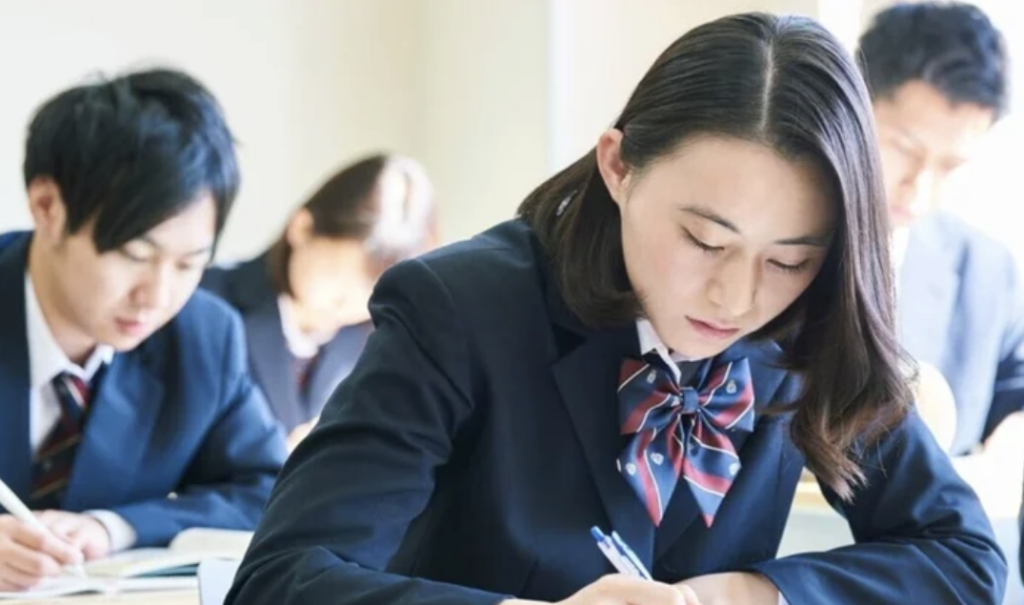
Entire class of 40 girls have school uniforms stolen from NY hotel

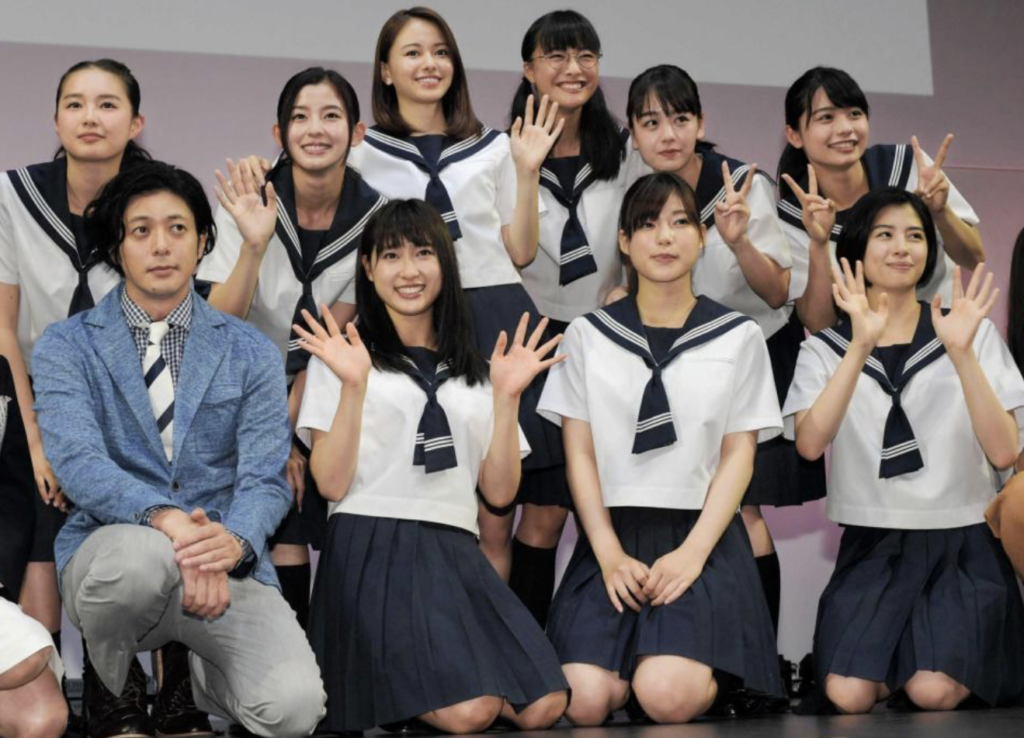
It was all smiles, except for the sheepish looking teacher, prior to departure at Narita.

Forty female students from a Chiba high school are grappling with the aftermath of a shameless burglary that saw their school uniforms stolen from their rooms on their last night of an exchange trip in New York City.

According to Deputy Chief Nick Frangalis, the students discovered their belongings had been stolen while completing their final packing prior to departing for JFK Airport.

“My unit is currently investigating this brazen crime,” announced Frangalis to a hastily assembled scrum of reporters at the hotel where the young ladies had been staying. “We’ve already determined that there were no signs of forced entry where the uniforms were taken. It also appears that only two specific types of clothing were targeted – the sailor tops and the pleated skirts, as no other items or money were stolen.”  Cops are currently analyzing the hotel’s security footage for further insights into the thief’s identity and whereabouts.

Deputy Chief Nick Frangalis addressing the pack of reporters.

The 3rd year high school students had been staying with families in Upstate New York just prior to moving to the city to enjoy a final weekend of sightseeing in the Big Apple.  The forty seniors had spent a culturally enriching three weeks exploring their various interests, passions, and desires with the purpose of broadening their minds and perspectives prior to graduation.

Anxious parents greeted the students at Narita Airport, their daughters returning to Japan with mixed feelings following their shock ordeal.  “We never in our worst nightmares expected our daughters to be targeted in such a disturbing crime.” said parent Sareru Gamama in a prepared statement. “I dread to think about how the uniforms are going to be used. This sordid incident has certainly found us all viewing America in a new way.”

Shielded from cameras and microphones, students stood to the rear while perusing their bulging duty-free bags of what appeared to be rather high-end items.  None of them were called on to respond to questions from the media, allowing them to try to put the incident behind them and spend time trading aloe vera, facial masks, foundation, and perfume.
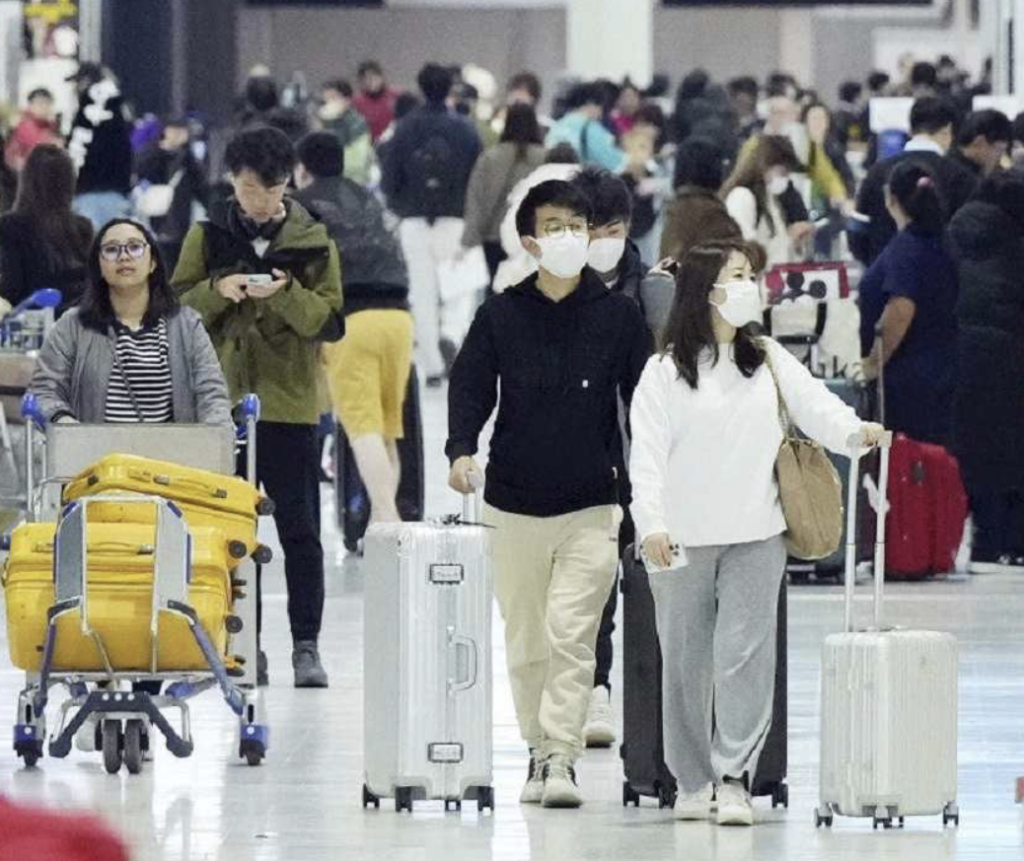
Despite the shocking news of the brazen theft, other travellers said that they were still keen to head to America.

High-profile teen psychology expert Seinen Madematsu was also on hand to provide counselling to any student experiencing trauma.  “We have to remember that these students are at a vulnerable stage in their lives, and an incident like this can leave them both shaken and sensually confused,” he beamed as he found himself the focus of attention.

“I’m here to offer my unorthodox but effective services pro-bono as I feel that this can help me in my continuing research, which just happens to focus on females in their late teens.”  The 53 year old veteran of no less than three books on teen-psychology then added that he was sacrificing time on the golf course as a way to further highlight his concern for the girls. 

“The golf course can wait.  Right now it’s imperative that I conduct these strictly confidential sessions where I’ll urge the girls to divulge their innermost feelings about the incident, their school-life, and the people around them, even their feelings about me.  There are many creepy teachers, coaches, and relatives in their lives, so it’s critical that they put their trust in me during our repeat counselling sessions.”
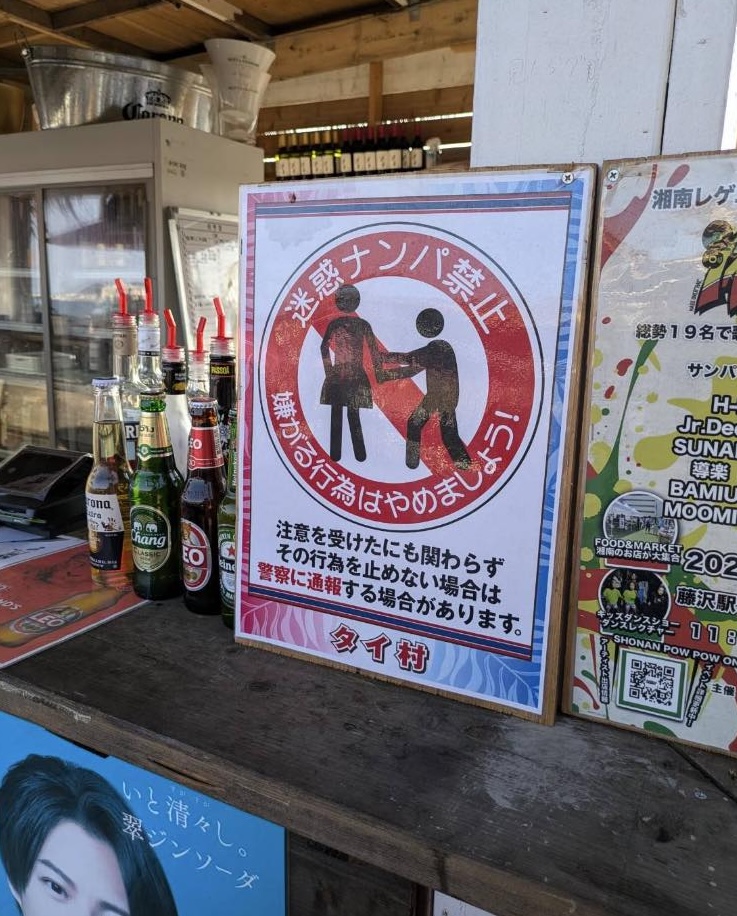
Mission Accomplished! Anti-Annoying Pick-Up Campaign wraps up in Shonan

The last patrol goes off incident-free.

First it was the tattoo ban, and then it was the annoying pick-up ban.  The result is that dickheads, little turds, wankers, and miscellaneous ne’er-do-wells have been sent packing, leaving only gentleman remaining at Shonan Beach following a successful police-led campaign which wrapped up yesterday.   “I haven’t seen any guys pestering women, hoping for a frolic in the water, at all this week,” beamed Chibusa Burasagari, head of the twelve-person task force.  “I’m delighted to see these girls being free to get completely plastered next to the ocean in a safe and comfortable way.”

A well-placed reminder that annoying pick-up methods are against the law.

For years any young woman has had to put up with largely unwanted harassment whenever they’ve come to Shonan to swim  (although the word “swim” is being used here in the broad sense of being physically in a body of water which is knee-deep or more).  And, while sexual assaults are extremely rare, for many women a day at Shonan has meant strange men brushing up against their arms, breasts, and buttocks, quite often when the woman is making her way back to her towel with a drink and a food tray, completely defenceless.

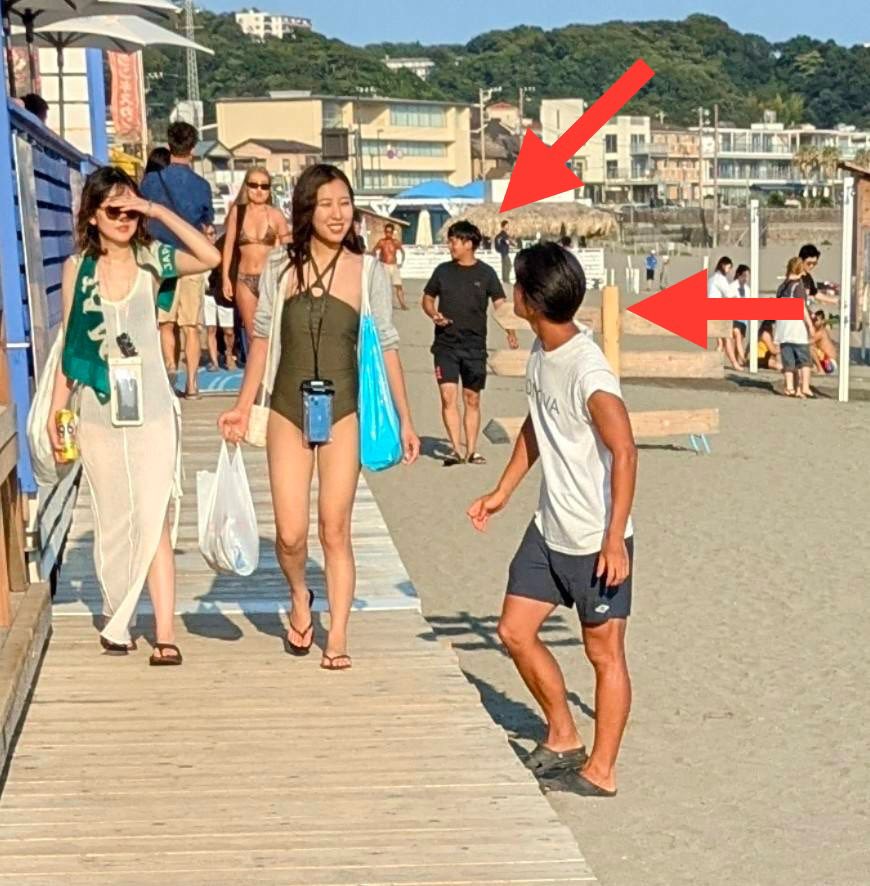
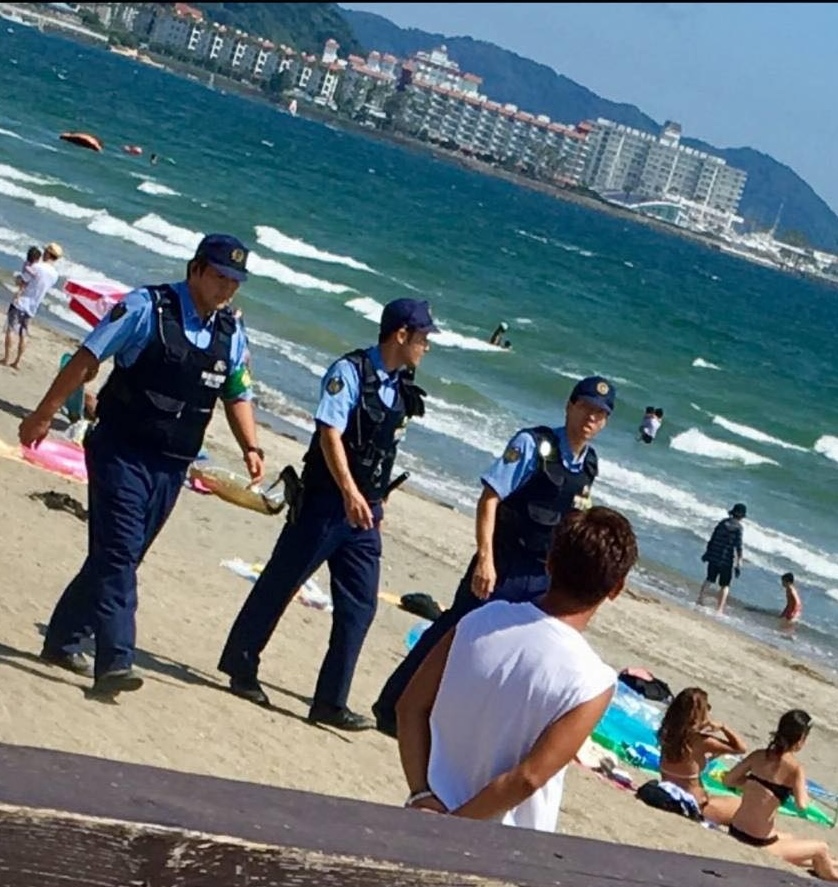
These two guys may look like pick-up artists, but they are actually plain-clothed police officers, giving helpful advice to the young female beachgoers.

“It’s a weird feeling, but it’s a good feeling,” said 20 year old Biko Kasashita from Machida.  “All we have now are beta-males and homosexuals sharing the beach with us girls.  There are a few older western guys shamelessly mentally undressing us, and I’m fine with that.  It makes me feel like a woman.  As for the local shy guys though, their reluctance to engage with us just makes me worried about the future demographic make-up of Japan.  Our population is expected to decrease to around 110.92 million by 2040, fall below 100 million to 99 million by 2053, and drop to 88 million by 2065.

“Young Japanese people need to get down to business in a hurry,” continued the full-bodied engineering student.  “Remembering me in this cute bikini when you’re alone tonight and bashing one out isn’t going to help.  According to the 2015 Population Census, the working-age population has fallen to 77 million.  Soon every convenience store will be staffed by South-East Asians.  When that happens, interacting with foreigners will have become unavoidable.  Do we really want that in Japan?  This is a question these shy guys need to ask themselves.  They’re on full-time contracts, right?  They can afford to keep a potential bunny-boiler like me and two kids.”
The young ladies can now enjoy their day at the beach without the fear of being groped.

Not all beach-goers share Kasashita’s concerns about the population decline though.  Thick-lipped 21 year old company employee Aino Itonami has too many collections on her mind to focus on anything else.  “I’ve just acquired my 85th Happy Set toy, and my J-Soul Brothers accessories need an extra shelf to display them all.  I’m happy that no guys are persistently asking me to jump in the water with them, but that’s where my interest ends.  I leave that kind of stuff (the topic of population decline) to people who do stuff like read books and stuff,” she explained.

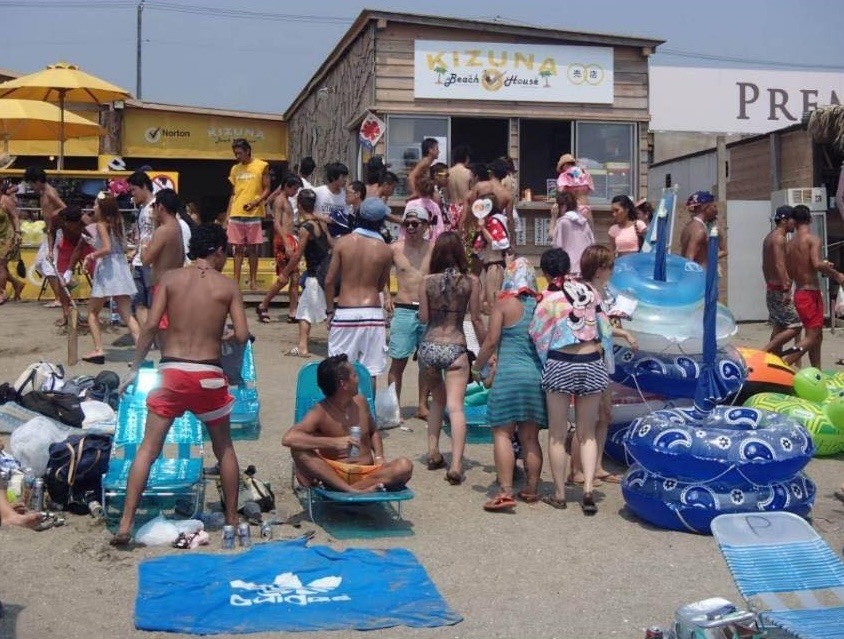
Lots of guys are still on the beach, but they’re the nice homely chaps that’ll buy flowers for their girlfriend’s mum.

Balding yet still handsome 48 year old Bostonian, Shannon Macnish, considers himself a distant onlooker in the goings on of the well-known beach.  “It’s time for decency to come to the fore here.  A new era can be nurtured along this strip of coastline, an era of common courtesy between the sexes,” urged the Kamakura resident of nine years.  “There have been too many pick-up coaches working this area, who have spread evil sexual philosophy.

“Guys have to go back to the basics of showing respect and transparent intentions.  They shouldn’t try to trick the girls.  They shouldn’t be sticking any foreign objects into the girls.  They should be saying to the girls things like, `I find your appearance enormously fascinating, and I’d long to spend time in conversation with you.  Do your feelings, by any chance, reciprocate mine?’ They should be setting the bar high for the kind of discourse they desire in a relationship.”

Indecisive young ladies are now left free to spend loads of time browsing the menu, free from constant interruption by local self-styled Casanovas.

Despite claims of success, some women are ambivalent about the new developments.  Criminally hot 20 year old Kiku Gezai was keen to have her voice heard.  “So the authorities are going to pat themselves on the back and move on to some other problem, like foreigners in Kamakura eating while walking.  But, the truth is that the guys on the beach now are still pretty creepy,” explained the local pharmacy student.  “The private security guys make out that they are our guardian angels, and try to get with me around sunset. They try to make you feel obligated for being protected. They have no social skills at all and just rely on their big muscles and disturbingly large chests. At least with a persistent pick-up artist you know the game that’s being played.”

Freedom from overbearing and overconfident sex pests is rightly being celebrated.

The relationships are all now in the hands of the young, clean-skinned, well-mannered Japanese, and the authorities and the good citizens of Shonan are just hoping for a fresh start leading to healthy romances and dignified outcomes, rather than the foul and disgraceful scenes of lewd behaviour that have been on display over the past five or six decades. 

It must be stressed that unplanned pregnancies are desired, but simply among responsible young people who have made small errors in judgement due to being overcome by lust. At this stage people are understandably pensive, as all it takes is one group of US military assholes, or a bunch of losers from distant Ageo or Kawaguchi, to destroy all the progress that has been made.

Rent-A-Cop Fossil sincerely believes he’s preventing some sort of crime

Checking the balance, or laundering money for an international gang?

72 year old Nobu Chisai’s usual day at the bank was turned wildly upside-down yesterday when a visibly non-Japanese man used an ATM inside the branch where he works.

The part-time security official’s regular routine of shouting out barely-comprehensible random greetings, gratitude, and not much else came to a halt as a western man took his place in line. Knowing full well that a crime of some description could be taking place, Chisai make his presence known by coughing loudly in the bank customer’s ear when he was waiting in line, withdrawing money, and leaving the building. He also breathed stale coffee onto the back of the customer’s neck during the transaction as he tried to peer onto the screen.

It’s all hands on deck as this security department works unpaid overtime pursuing a cunning scammer.

“There have been many “It’s me” scams and money laundering operations going on in our society,” said the elderly employee as he brushed imaginary fluff off his flimsy looking epaulettes.  “And while local gangs are entirely to blame for this, I couldn’t rule out the possibility that a regular customer coming in on a payday was up to no good.  Therefore, I had to let him know that I had eyes on him. Who knows?  Perhaps he’ll think twice about withdrawing his hard-earned money again.  Whatever the case, I’m sure that the big boys in Marunouchi appreciate my diligence.”

The croc waits! Do not for one moment think hes sleeping. Its merely his way of luring a scammer into a false sense of security.

Upon arriving home and sitting down for his dinner, Chisai remarked to his wife that his day had been “a struggle” due to the western customer coming in.  His wife nodded and responded that there were a lot of foreigners around these days.  With that acknowledgment of the world changing around them, the pair ate their meal in silence… fearful silence… a silence that could be broken at any time by news of a foreigner doing something… in an area that they’ve heard of… in Japan.

It’s Japanese!? In that case it doesn’t suck

A sad and lonely looking playground

A park that had been regarded as symbolizing “disgraceful urban neglect” has been redefined as a showcase of “superb engineering and foresight” following the discovery that it is actually located in Japan rather than South Side Chicago. 

George Sato, an outsider within the non-profit City Parks Observation Trust, explained that once it was realized that the pictures featured in a report were from a park in Tokyo, the tone of the report changed to one of overwhelming positivity.  “The usual whiners were using the pictures to attack city planners, saying that the money for maintenance was clearly being siphoned off to self-interest groups and pet-projects,” he said.

It’s called either a globe jungle, a cage roundabout, or a Bronx spinner

With the swings, cage roundabout, and slide showing signs of general wear and tear it was assumed that the photos were from an inner-city slum, and that the photographer had carefully edited out the anti-social characters who occupied it. When the Japanese-American Sato pointed out the tell-tale signs that the photos were from parks in Japan, those same vocal minority types did a complete 180 on the topic, going on about how the Japanese care so much about preserving old things so that future generations can benefit.

A red concrete octopus, in particular, was initially the subject of scorn.  “What purpose is this supposed to serve!?  It’s just a concrete ball painted red, for Christ’s sake!  What kid is going to play around that!?  Another fail for city strategy and budgeting!”  screamed the review, which was altered in Orwellian style to, “This gorgeous octopus shows the unique Japanese less-is-more approach to life.  Whereas we Americans would spend loads of money on cookie cutter equipment, the Japanese observe what children like and create art accordingly.”

Popular with the kids as well as the dads

For the usually-ignored Sato, it was a shock to have people listening to him as he used key visual details to pinpoint the exact location of the park.  Still, the sudden respect paid to him didn’t stop him from copying the original report in order to embarrass one or two colleagues who he can’t stand. Sato was also keen to point out that he has no idea of how the pictures came to be in the office.

The cover-ups have been numerous. One particularly scathing line of criticism, “My God!  How long has this equipment been around for!?  It looks like it’s been repainted by unskilled workers a dozen times.  Nice going City Hall!  Way to go taking a dump on the needs of our children,” was quietly changed to, “As opposed to the American throwaway society, Japan knows how to make their public facilities and equipment last for generations.  In this way, the needs of their children are continually attended to by members of the community.”

Delightful rustic charm

The lack of grass didn’t escape attention in the original description either.  “I dread to think what kind of scrapes and cuts occur here every day.  Safety is obviously far from a priority in this case,” became the delicately tweaked, “Conserving precious water reserves is a priority in this case, and the children have been raised to understand this and play together nicely in order to avoid injuries.”

The photos and the accompanying report have triggered an unexpected reaction amongst bureaucrats in the town of Stauffenburg, Illinois.  In a statement released at 5:25pm on Friday just prior to an eagerly awaited professional sports game, the city announced that ten officials would soon be visiting Japan on a week-long fact finding mission in an effort to gain a vital insight into park maintenance.

English band releases song featuring acerbic observation of UK/US cultural difference

Frisona will be playing at a modestly-sized venue in Tokyo, but they also plan to visit Tokyo Dome during their trip.

On the eve of their whistle stop tour of Japan, Frisona, a young English band hailing from a provincial town in Upper Clackershire, look set for a big year with the release of their new song, “Across the Atlantic”. The band sat down with me over some pints of rather foul, dark beer and discussed how they are feeling about touring the states in the near future.

Lead singer Oliver Meadows said he was nervous about whether American audiences would “get” the sarcastic tones contained in the lyric, “You can keep your diner, coz we’ve got our greasy spoon,” which is repeated a dozen times in the new release.

Frisona never tour without their very own scone lady, who is under strict instructions to serve them with the cream on top of the jam.

Says Oliver, “The song is actually the title track of our new album, and it’s a commentary on the Americanization of our homeland, which has been going on since the dawn of time. Sting kind of came up with the blueprint by singing about a bloke preferring tea to coffee. We are adding a whole lot more to that. Do you know, for example, how hard it is to find traditionally prepared jellied eel these days?”

Bass player Jimmy Alexander chimed in with his view on jumping aboard the Star Spangled Express. “I’m sorry to tell you this, America, but not everyone wants to drink Coca-Cola and eat a cheeseburger. What’s all the fuss about French fries anyway? Just give me a portion of chips with some battered fish, and I’ll pay for that in English pounds too, thank you very much. One thing’s for sure; you won’t find me wearing a baseball cap backwards and mumbling “What’s up?” to people as a way of greeting them in the morning.”

During arduous tours Frisona prefer to have their jellied eel procured from traditional establishments and flown across the world first-class whenever possible.

Given a sneak preview of some songs on the album, I was treated to a tapestry of jangly guitar pop with references to English stuff like going upstairs on a double decker bus, betting on greyhound races while chewing salted pork fat, and yomping in nature with the Territorial Army.

Try as I might, I was unable to coax the rest of the album out of the band. but apparently it features stuff about over-boiled vegetables, policing the streets of Burma, and an often-repeated conversation between two eccentric West End thespians in the tea room at Ealing Studios in 1973.

The rush is on to get on board during rush hour

Commuters preparing for an enjoyable journey on the Tozai Line

“My mother and two of my junior high school teachers used to tell me that I was clever, and that I had so many interesting ideas,” says 32 year old Tokyo resident Jasper Watson.  “I guess this tour shows that they were right.”  

Watson is referring to his enormously popular Tokyo subway tour, which began during the waning days of the Covid Scare.  While other tours focus on temples, shrines, and traditional culture, Watson’s tour plunges into the heart of rush hour, giving visitors a taste of commuter hell on the Tozai Line on weekday mornings.

An Indian would probably climb up on the roof

“It’s kind of like those restaurants in France where you dine with the expectation of being insulted.  Some people want others to cough directly into their face or have their buttocks clutched roughly.  Sure, some people get freaked out, but some sign up to do it all again the next day,” grins the cocky Canadian, who was fired from his English teaching job due to chronic tardiness three years ago.   “Some of the female commuters can’t leave my black customers alone.  They want to squeeze, rub, and even poke their backsides like one of those jelly ball stress removers.  Half of my customers get freaked out and get off at the next station, but the other half come back the next day for second helpings.”

Watson points out that, despite putting in zero capital input for his tour, there are still truckloads of day-to-day worries.  “I have to constantly tell the Scandinavian customers to ease off on the chat.  Tourists speaking English at high volume is bad enough because it brings back memories of annoying ESL teachers who thought they were cool and spent lots of time with the girls in the classroom.  I’ve found, however, that languages like Finnish or Swedish can really get up people’s noses on the train.  I don’t know why, but they set people off.

Tourists take a deep breath after they escape the subway crush.

Bureaucracy usually has a way of involving itself in any tourism related business, but so far Watson hasn’t had anybody turn up unannounced at his door. “As far as officialdom is concerned, I don’t have a license but, then again, the authorities never envisaged this kind of tour.  That’s how out-of-the-box my ideas are.  I guess that makes me the kind of person that the authorities can’t reach.  I’m comfortable with that label, by the way.  It suits me.

“Some people ask me why these foreign tourists can’t simply get on the subway themselves without paying extra for the tour. Those kind of people have no sense of economic opportunity and would never ever have a business dream.  That’s what separates us.  These tourists are prepared to pay extra to guarantee that they are guided directly into ground zero.  Some of them will never come back to Japan.  Generally, they only get one chance, so they want an expert to get them into the thick of things.

Commuters try to get as comfortable as possible during their journey.

“It’s not all bad news on the Tozai Line.  Many of my customers are pleasantly surprised to see cute students on their way to Waseda University.  These young ladies really shine like roses in a swamp, and they offer a glimmer of hope amongst the young working men that perhaps one such beautiful woman will be come to work in their department in the near future. That won’t happen though.”

The tour, says Watson, has come along in leaps and bounds since the early days.  Tour participants now receive laminated cards at the beginning of the tour to enable them to understand what is being said around them.  “My customers appreciate being able to quickly comprehend common insults and complaints.  I get some real masochists too, who delight in hearing that their level of hygiene doesn’t  meet the generally accepted Tokyo standards.”

こんにちは、お兄様達

Watson is aware of the need to conduct his a subway with minimal impact. “Right now I’m just focusing on reminding my customers to dress appropriately on the subway. They need to show consideration for others while having a cheap holiday in someone else’s misery. That’s why I tell the overweight westerners not to wear such figure-hugging clothes.  It’s demoralising for workers to start the day having to see all that flab,” he explains with a shake of the head.

“I’m conducting tours every day and the outlook is pretty good.  The platform attendants know me, and I even get a little bow from them regularly.  They know who I am, and they know that I’m a considerate, respectful, and responsible guy, and I’m sure that they remind each other of that when they chat about their favourite commuters. But, I’m not stopping with this tour. I’ve also got big plans to start manhole cover tours. The Italians, in particular, go crazy for the sewerage related infrastructure. Although, to be honest, they’re amazed whenever they see public infrastructure that thieves haven’t run off with.”

Long-term jaded Tokyo resident still comfortable drinking in Golden Gai

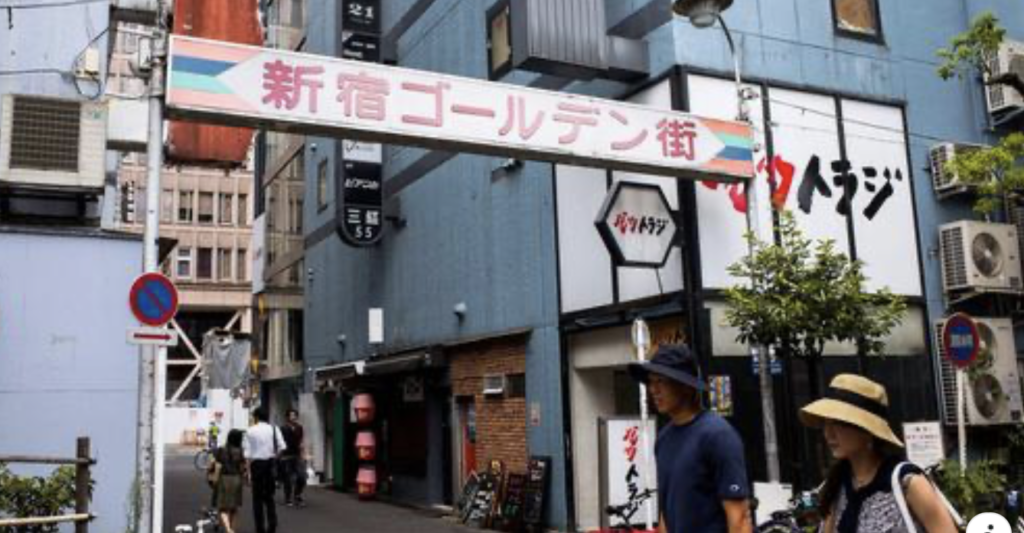
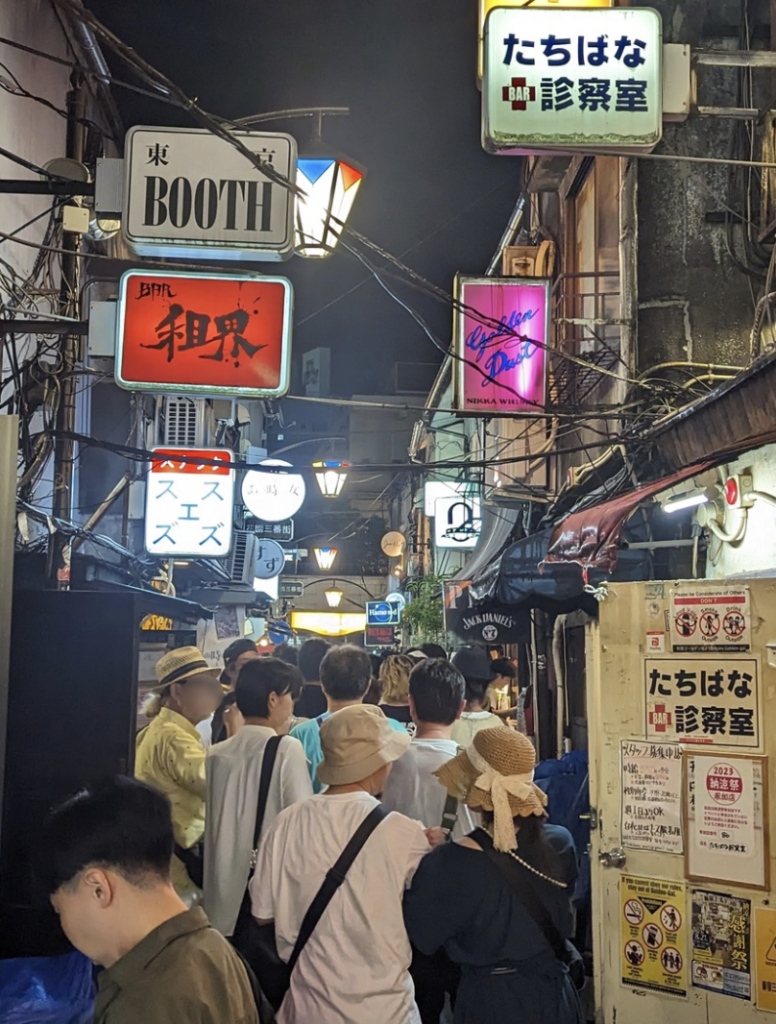
Shinjuku Golden Gai… looking pretty underwhelming during daylight hours.

“How long did you say you’ve lived here?  17 years!?”  It was a question many a tourist has asked 45 year old Rob Petraglia.  “Wow!  You must really love Japan!” gushed the 21 year old Australian backpacker sitting next to him.  Petraglia, perhaps unable to find the enthusiasm to match his temporary buddy, nodded wistfully and let out a slightly audible, “…… Yeah…”

Long-term foreign residents of Japan typically find their niche after a few years.  For some it will be hiking in the mountains or cycling the isolated country roads.  There will even be the odd outdoor enthusiast who will develop a following online, with westerners hungry for unique perspectives of a land that they yearn to visit.  For Petraglia, however, the metropolis of Tokyo still manages to keep the slightest flame of a desire to live from dying out inside.

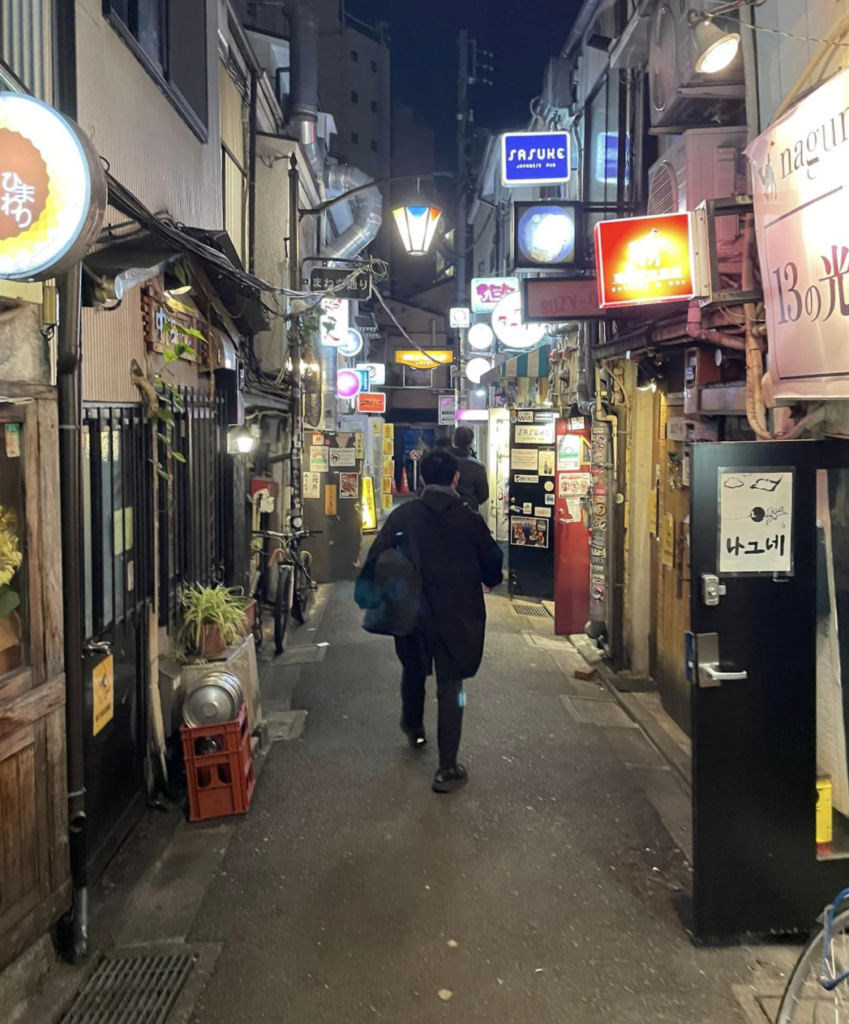
A brightly lit, yet lonely place during Covid.

The divorced Canadian, with two anchor children living in a Saitama house with his unstable ex-wife, has found that Golden Gai is the one Japanese cultural area that he still frequents.  All the reasons he had for loving Japan a decade ago have disappeared from his life, except Golden Gai.  Now, although overrun with short-stayers, Petraglia clings to the place like an entitled beaver clings to its mother, unable to comprehend that it’s overstayed its welcome.

“I live in a 1DK studio apartment in Kita ku and the walls can close in from time to time.  I drink in Akabane, Oji, and Golden Gai.  That’s my monthly rotation,” he explained.  “Once a month I’ll stay at home to save money and I’ll just spend most of the weekend picking fights on social media.

Let the mingling begin.

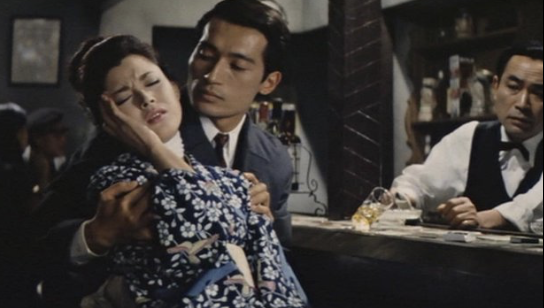
“When I first came to Golden Gai, the bars didn’t have English menus, and everything felt like a Masumura movie featuring Ayako Wakao, but not the one where she has an affair with another woman.  No, it wasn’t like that.  It was more like one of the other Ayako Wakao movies where she plays another kind of highly emotional character.  Sure, the place lacks that Showa vibe now, but I still come here because I don’t have anything better to do.

“Hot springs are wonderful and the volcanoes are amazing.  I’ve been there and done that. I even once considered exploring Gunkanjima,” he mutters while staring into his beer. “I never followed through on that plan though. There are some who long to take photos of those crumbling buildings, or a wild tanuki, or even a wild tanuki moving through those old buildings. Then they want to bathe in instagram glory for a few days.  That’s not me though.

Ayako Wakao testing her man’s kindness, patience, and gullibility.

“Some people have accused me of failing to move on to things more appropriate for my age.  And, while it’s true that all I do is get blitzed like I did when I was twenty years younger, I find that I don’t mind mingling with tourists half my age who talk about bands that I’ve never heard of, and have no desire to listen to,” he states in a moment of remarkable self-reflection.

“You won’t find me trying to find yet another Tottoro-style country vista.  I can guarantee you that.  While those outdoor types are discovering delightfully refreshing mountain streams, I’ll either be at a bar or in my apartment watching hockey and calculating how many more paychecks it’ll be until my youngest kid graduates from high school.”

Pressure builds as Aussie skiers overuse anal showers

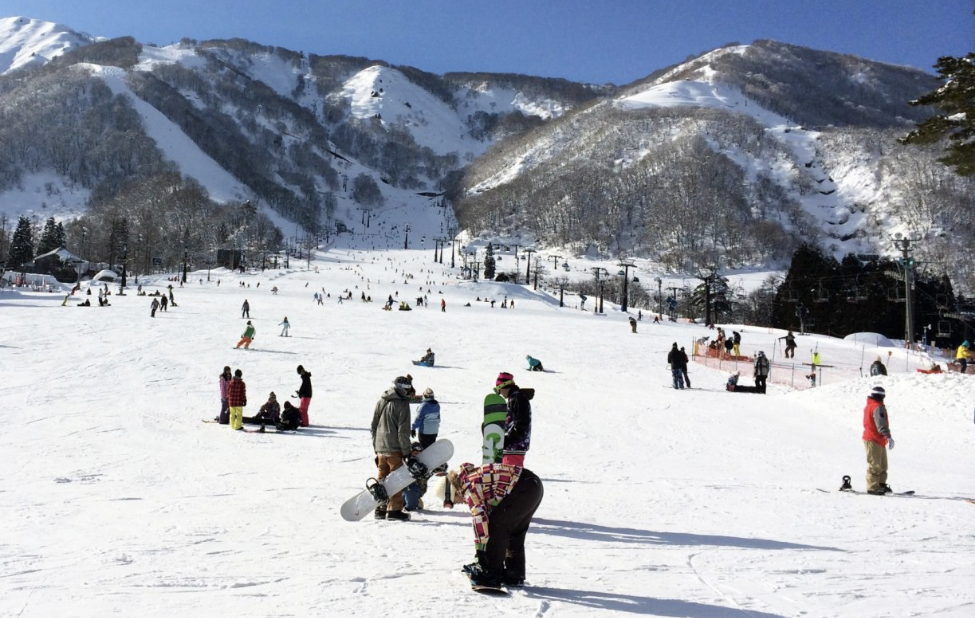
Aussies are being encouraged to spend more time on the slopes and less time on the crapper.

Ski field hotel owner Ketsu Kitsui is facing higher costs across the board and, after a great deal of analysis, he’s finally found something that he can put his finger on; Australian backsides.  The issues of rising costs of food, energy and wages are presenting great challenges to hotels and pensions throughout Japan. Reports suggest guest numbers grew in 2022 and again in 2023/24 winter, however such growth is being spanked by soaring inflation and general business expenses.

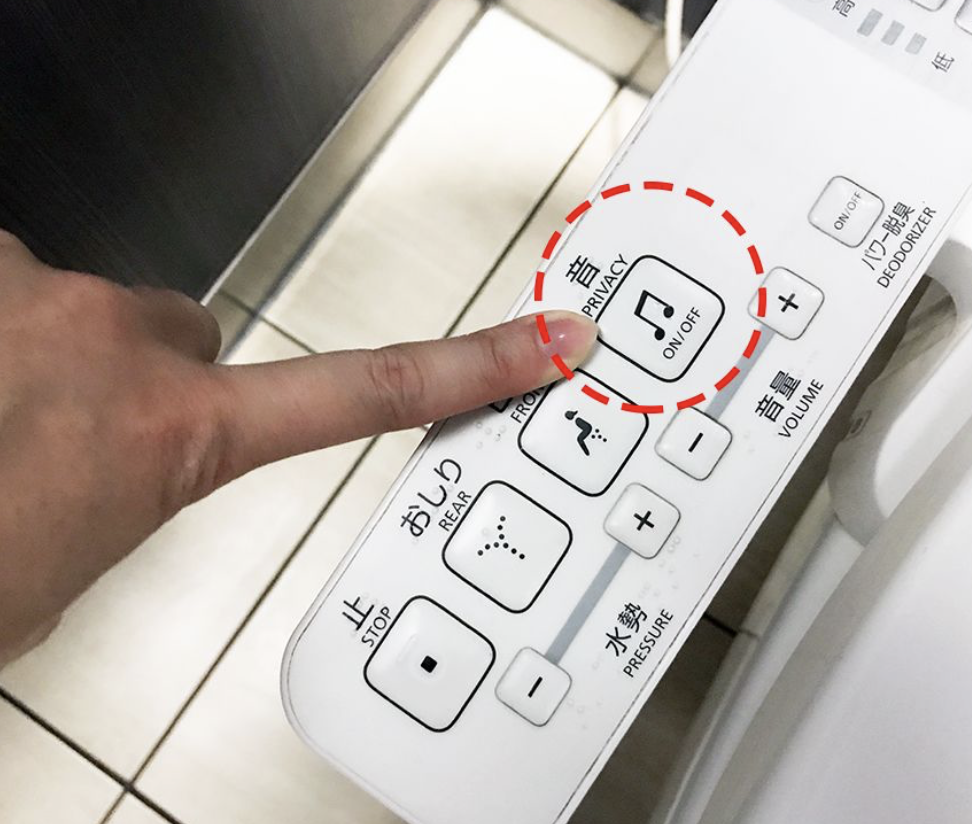
Kitsui, whose hotel is situated in mountainous Toyama, explained the reason behind his major problem.  “Australia is a land of three minute showers.  That means that when they come here, they get a bit cheeky with the free water.  In particular, they’ll sit on the toilet watching cricket on their laptops while they have water spraying their rectums.  And, as you know, cricket games go on forever.

For many people test cricket is a complete bore, but fans say that there can sometimes be buttock-clenching tension in the game.

“These Australian guests love getting their bumholes jet-washed.  Word of mouth has spread faster than a mooning teenager’s bumcheeks, and now we’re fixed with ever-increasing water and electricity bills.  Don’t misunderstand me; we’re happy that the Aussies are behaving in a hygienic way.  For too long they’ve been pushed into the great unwashed category with the English.  It’s good to see them escaping from that stereotype, and they’ve helped us to zero in on an untapped area of the market.”

Katai Unchi, another hotel owner, agreed wholeheartedly with his business rival, “We’re concerned about all these cracks.  Cracks have been appearing in our business model.  We are used to being in the black, but it’s looking grim now, like we’re staring into a nasty looking crevasse.”  Unchi, who wears an eye-patch following a near fatal collision on the slopes five years ago, knows that tough times are here.  As I looked deeply into his dark brown eye, I was able to understand just how tight things had become.

Guests can even listen to Olivia Newton-John while taking a snap.

“Grapes are being affected too,” he continued.  “We like to have a complimentary bunch placed on bedside stools in the rooms as a welcoming gift, but we may be forced to stop this practice.  Inflation has led to higher prices across the board.  The cost of our entire cafe selection, things like date fingers, chocolate starfish, and fruity buns have been pumped up recently. 

“Once we had piles of cash in the office, piles just sitting around, sometimes being blown around when the backdoor was left open.  Not anymore though.  We really have copped a lot of punishment lately.  Our power bills had bottomed out thanks to LED lighting, but they’ve slowly reared up due to this Aussie trend for clean clackers.”

The traditional J-toilet. Is it Shinjuku Station or Matsudo Keirin? You be the judge!

In addition to the economic uncertainty,  communication problems still arise due to pronunciation errors.  “The vocab and grammar can be picked up with just a little commitment, but pronunciation can be tough.  The Japanese r’s can be a handful to deal with,” said Di Ariah, owner of a Hakuba snowboarding school.  Her number two, Con Stipatis, explained that some words require a delicate roll of the tongue, “so the little Japanese r’s can take time to come to grips with.”

The balancing act continues; how to conserve energy while avoiding crap reviews by ensuring guests enjoy themselves without compromising quality.  But it’s clear to see that the healthy market for clean bumholes hasn’t been fully penetrated yet.

Departing language teacher declares – “It’s up to the locals now”

Ralph-Smith says hell miss the joy of seeing the students putting in an effort to improve their English skills.

The end of the Japanese school year usually brings change, and this year is no different.  But few people could have predicted the huge change in the zeitgeist this year, with the recent decision of well-known English teacher Carter Ralph-Smith to finally go back to his hometown in Australia.

As a man who has spent more time in Japan than he cares to remember, the 46 year old Aussie has generally been regarded as a lifer, a person with very little to offer in any area outside of teaching his native language in Japan.  The recent death of a childless family member, however, has meant that Ralph-Smith now has the means to make a triumphant return home.  

Ralph-Smith says hell miss the joy of seeing graduating students being congratulated by their proud parents.

“I’ve done my part to improve the level of conversational English in Japan,” said the Wodonga native.  “It’s up to the Japanese themselves now… and maybe the Filipina who will replace me.  We are seeing a de-Westernization taking place, but the Japanization of Eikaiwa is what is required now.  The locals are in the best position to decide the right path out of this katakana-rooted mess.  I mean, have you ever watched an AKB48 election on tv?  They say every bloody number in that long, annoying, warped way.  Jesus bloody Christ!  If these people aren’t overcomplicating everything by observing every grammar rule, they’re buggering it up with that weird pronunciation.

According to Ralph-Smith, a Japanization of Eikawa would involve not only the strengthening of the teaching force of the Japanese in numbers, equipment, leadership and teaching skills, but also the extension of the conversational program [i.e. DVDs and games to families] throughout Japan.  “Family-focus, the second component, presents the real challenge,” explained the veteran instructor.  “It is benevolent government action in areas where the government should always be benevolently active which is critical.  It shouldn’t just involve piles of cash going to their mates to produce inferior material that doesn’t invigorate anyone.  The government should be doing what is necessary if Japanization is to work.”

Ralph-Smith says that this is the future of English study in Japan; just one local teacher, but with perhaps a little less kanji on the blackboard.

Ralph-Smith went on to suggest that a revolution was required to deal with the status quo.  “English conversational development simply cannot wait a year for old bureaucrats to decide to take some new step and take a more conservative position.  These issues must not be placed, for all practical purposes, in the hands of the current bureaucracy, which does not want to resolve them and is unable to do so, since it is unable to soberly assess the situation.  As things stand at the moment, there is an over-reliance on Americans with yellow-fever and irresponsible Australian backpackers.

Ralph-Smith also took the opportunity to deal with rumours around the reason for his return home.  “What the hell are people talking about an inheritance for?  Yes, there has been a transfer of a certain amount of funds which will come in very handy, but that has had no bearing on this decision.  I just feel, and I think that most instructors feel, that the time has come to get out of Japan.”

Ralph-Smith’s Hub loyalty card is expected to remain in Japan, with a handing-over ceremony due to take place the night before his flight home.

Kanto City Office Worker bewildered by mixed-race families

Despite having worked in the Births Registration Section at Kakeochi City Office for sixteen years, and despite Kakeochi City having more foreigners than dogs within its boundaries, Katsurei Uketa still struggles with the concept of a family featuring a non-Japanese member.

City employees would feel shame if a new family were ever to leave this place smiling.

“Huh… The baby’s name is Natsumi… Parker… !?  And… she’s Japanese…!?” exclaimed the overweight and unfashionably unshaven 38 year old lifetime public servant.  As he took the forms from the beaming parents, Uketa proceeded to stare at them in the manner of a North Korean reading a book which shows Japan in a positive light.

Taking utmost care not to betray the fact that he serves people in exactly the same situation at least once a week, and that the procedure ought to be straight-forward with a minimum of fuss, Uketa’s only utterance for the next ten minutes is a laboured “Hmm…” as he handles the papers much in the way of a detective sifting through delicate yet incriminating evidence, his only reaction being to tilt his head every minute or so.

Failing to find even the smallest error that would allow him to unempathetically send the family away from his desk, Uketa humourlessly completes the paperwork and then abruptly directs the young family to another section of the office where they will be required to do just about everything they’d just done all over again.

I’d forgotten to get a photograph of Uketa serving a happy family, so I desperately grabbed a quick snap of him murdering a hamburger.

It’s a scene that occurs regularly at the city office, and precious westerners love retelling embellished versions of their encounters with friends at izakaya and British-themed chain pubs. But the experience from the other side of the counter is rarely heard, or even considered. Taking this gap in information on board, I decided to sit down with Uketa last week to shed some light on the matter.

“Look, I’m just doing my job to the best of my ability, and if that’s not good enough for some entitled westerners then they need to adjust their standards,” he explained.  “Half of these Europeans and Yanks are leftie do-gooders anyway.  I’m just giving them a taste of what life would have been like in the Soviet Bloc every single day.  Imagine being served by someone like me for every conceivable transaction; at the bakery, the butcher, and the izakaya.”

In addition to the slow service, applicants are directed to purchase revenue stamps from this snack stand located across the road from the city office.

While getting stuck into his barely-earned lunch, Uketa revealed that there is an international side to his actions, which can be seen when he stares at a form put before him silently for two minutes.  The poker face is, in fact, an instinctive reaction to any receipt of a formal document.  “I was trained by a stone-faced, elderly woman from the DMV in Ohio,” he says between highly off-putting chomps on a burger in the city hall lunch room. “My key takeaway from the course was to never act assertively or show an inch of initiative to help a client.  Staring blankly at a form for what seems like hours is all part of my training.”

The pachinko-loving Saitama native also carefully laid out the perplexities he often has to deal with. “I can’t imagine how these people in international relationships meet, how they court, and how they live together. What happens in the house when the Japanese woman cooks dinner?  Can the husband eat Japanese food?  Can he use chopsticks?  Can he respond appropriately when his sexless mother-in-law tries to pleasure him at the kotatsu

The strain shows on the face of the father in this mixed-race family after another encounter with local bureaucracy

“I’ve even heard about one Australian guy who was just into having regular naked sex with his wife,” continued Uketa who was now embracing the opportunity to let it all out. “He wasn’t using any ropes or uniforms, and he was finishing inside her rather than on her face or breasts. Umm… What happened to doing as the Romans do when in Rome!? That guy sounded like some kind of imperial pre-invasion plant.

“And, what about the relationships when the man is Japanese?  It must be hard for him using a knife and fork all the time and dealing with all those cultural differences. What about when they have sex? I guess he has to learn tag questions to confirm that she likes what he is doing to her every 30 seconds. What should he do when the woman gets into crystals and essential oils? It all seems like an enormously stressful way to live.”